Digitalizing Skills Development Through Mobile Training Technologies
A research and innovation institute advancing simulation-based mobile training, m-training applications, and future-ready digital skills development.
About the Institute
The Institute for Mobile Simulation Technologies is a private research and innovation initiative dedicated to advancing the field of mobile training technologies and practical skills development.
We focus on developing simulation-based mobile training solutions that bridge the gap between theoretical knowledge and practical competency, making high-quality skills training accessible anytime, anywhere.
Through rigorous research, innovative application development, and strategic partnerships, we aim to transform how technical and vocational skills are taught and learned in the digital age.
The institute is the public-facing research and innovation brand of Mobile Simulation Technologies OPC, based in Davao City, Philippines.
Research
Evidence-based innovation
Innovation
Cutting-edge solutions
Impact
Transforming education
Excellence
Quality-driven approach
Why Mobile Training Matters
Mobile training breaks down geographical and temporal barriers, making quality skills development accessible to learners anywhere, anytime. No longer confined to physical workshops or classrooms.
Through carefully designed simulations, learners can practice complex tasks in safe, controlled environments. Mistakes become learning opportunities without real-world consequences.
Mobile training provides step-by-step guidance, immediate feedback, and adaptive learning paths that respond to individual learner needs and progress levels.
What Makes Us Different
- •Content-focused knowledge delivery
- •Information consumption and retention
- •Theoretical understanding emphasis
- •Assessment through tests and quizzes
- ✓Task-oriented skill development
- ✓Simulation-based practice environments
- ✓Competency-focused outcomes
- ✓Performance-based assessment
Our Focus: We specialize in m-training solutions that go beyond information delivery to develop actual competencies through interactive simulations, guided practice, and performance-based assessment.
Research & Publications
Digitalizing skills development using simulation-based mobile (SiM) learning application
Authors: Louie C. Juera
Journal of Computers in Education (Scopus, Q1) (2022)
Show AbstractHide Abstract
In a volatile, uncertain, complex, and ambiguous (VUCA) world, education and training providers need to explore other pedagogical approaches in conducting technical and vocational courses. This study introduced a new approach to conducting electrical engineering related laboratory activities amidst online or hybrid learning modalities. Primarily, this paper examined the potential of using simulation-based (SiM) mobile learning application to develop technical and vocational skills of the users. The researcher-developed mobile learning application, Electrical Wiring Simulator (EWS), was used to collect the responses from the 345 users worldwide who downloaded the software from Google Play. The majority of the respondents came from the Republic of the Philippines, USA, Indonesia, India, Mexico, Myanmar, United Kingdom, Malaysia, and Portugal among others. The respondents reported a high potential to develop electrical wiring skills when using EWS. The results from Multiple Linear Regression Analysis indicated perceived usefulness (PU) and ease of using the mobile simulator significantly influenced the user's potential electrical wiring skills development. Lastly, the PROCESS macro showed that there is not enough evidence to show that the generation of the learners significantly moderates the effect of perceived ease of use on potential skills development.
How does mobile training (m-training) differ from m-learning? A systematic review of trends, technology modalities, methods, and training outcomes
Authors: Louie C. Juera, Maricar R. Casquejo
Interactive Learning Environment (Scopus, Q1) (2025)
Show AbstractHide Abstract
Mobile technologies have reshaped the landscape of education and workforce training; however, research on mobile training (m-training) pedagogy remains fragmented and is often conflated with broader mobile learning (m-learning) approaches. This systematic review addresses these issues by delineating m-training as a distinct, skills-oriented approach and by synthesizing recent evidence on research trends, technological modalities, methodologies, targeted skills, and training outcomes. In line with Preferred Reporting Items for Systematic reviews and Meta-Analyses (PRISMA) guidelines, 92 relevant studies from 2014 to 2024 were analyzed. Findings indicate a marked growth in m-training research output since 2017, with a strong focus on applications in medical, engineering, and language education. Scenario-based training emerged as the predominant modality, while the adoption of augmented and virtual reality tools signals new directions in the field. Research methodologies were dominated by design/development, experimental, and mixed-methods studies, with technical skills as the primary training outcome; nevertheless, there is a rising emphasis on soft skills and the integration of multiple competencies. Notably, all studies reported positive impacts on learner proficiency and knowledge acquisition. These results highlight the unique contributions of m-training to digital education, provide actionable insights for practitioners and developers, and identify priorities for future research, particularly in underexplored domains and with emerging technologies.
Featured Explainer
New dedicated page: What is mobile training?
Explore our search-friendly explainer on mobile training, m-training, mTraining, and how simulation-based mobile training differs from general mobile learning.
Featured Study
Mobile training systematic review study page
Visit our dedicated study page for the review article on mobile training and m-training. It summarizes the paper, presents the citation clearly, and links to the official Taylor & Francis publication record.
Mobile Training Applications



Logo Meaning
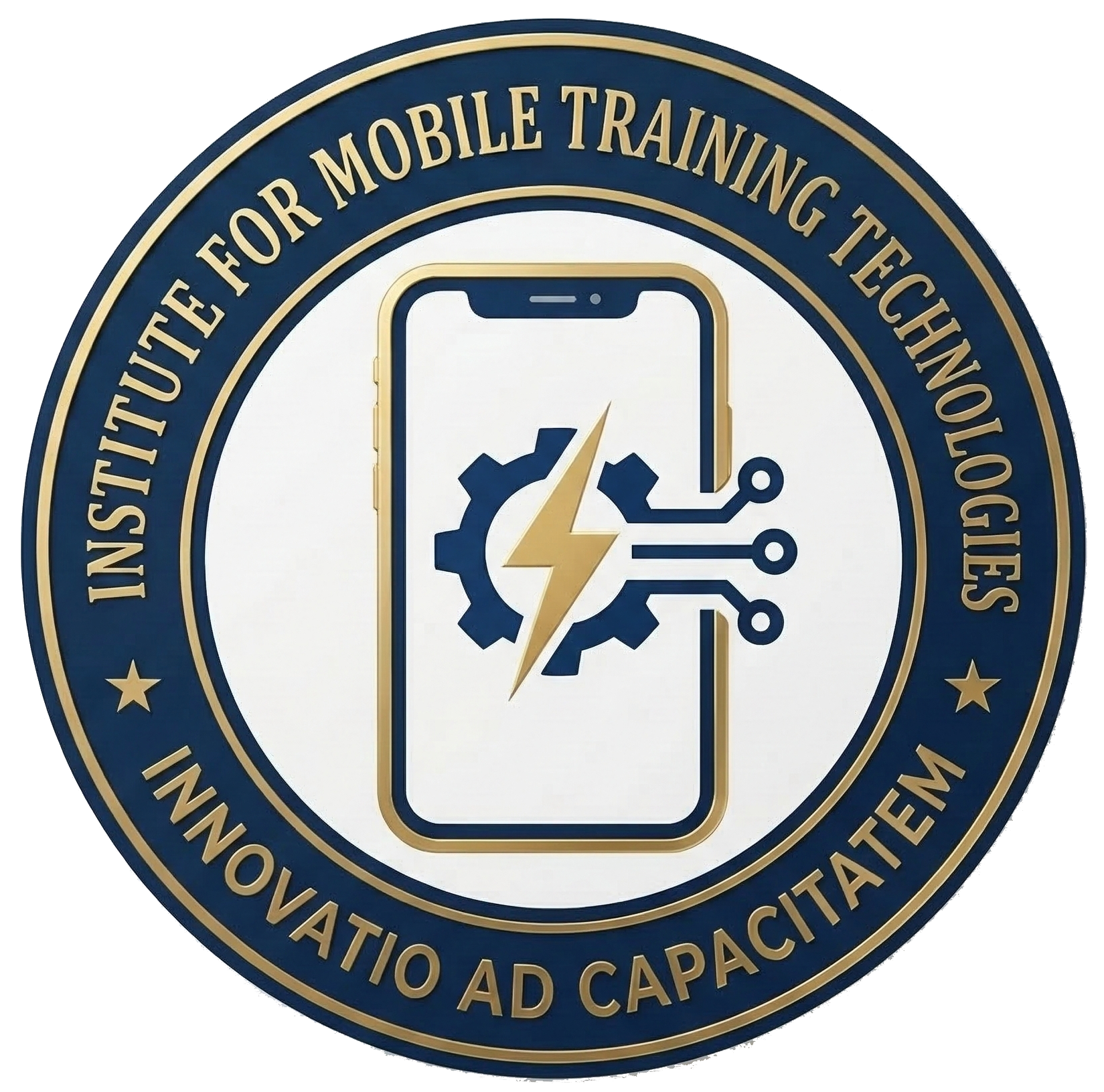
The company logo is designed as a premium academic-style circular seal in navy blue and polished gold, expressing trust, authority, and quality. The outer ring establishes formal identity through the institute name, "INSTITUTE FOR MOBILE SIMULATION TECHNOLOGIES," and the Latin philosophy, "INNOVATIO AD CAPACITATEM" (Innovation towards Capacity), which reflects the mission of building practical capability through innovation.
At the center, a golden smartphone outline represents mobile delivery of training. Inside it, the blue gear symbolizes technical precision and competency-based skills, the golden lightning bolt represents innovation and speed, and the circuit traces with nodes signify electronics, connectivity, and digital learning pathways. Together, these elements present a unified visual narrative of digitalizing skills development through mobile technologies.
Vision
To be a globally recognized leader in mobile training technologies, transforming skills development through innovative simulation-based learning solutions that empower individuals and organizations worldwide.
Mission
To advance the field of mobile training through rigorous research, innovative application development, and strategic partnerships, making high-quality competency-based training accessible to all learners.
Goals
- •Conduct cutting-edge research in mobile training
- •Develop innovative training applications
- •Build strategic partnerships globally
- •Promote evidence-based practices
Partnerships & Collaborations
We collaborate with universities, research institutions, and industry partners to advance the science of mobile training and validate our approaches through rigorous empirical studies.
- •Joint research projects
- •Co-authored publications
- •Shared resources and expertise
We work with educational institutions, training centers, and organizations to implement and evaluate our mobile training solutions in real-world settings.
- •Pilot program implementation
- •Custom solution development
- •Training and support services
Interested in Collaborating?
We welcome partnerships with organizations that share our commitment to advancing skills development through innovative mobile training technologies.
Founder & Director

Engr. Louie C. Juera, Ph.D.
Founder & Director
Dr. Juera is a researcher and innovator specializing in mobile training technologies and simulation-based learning. With a background in engineering and educational technology, he founded the Institute for Mobile Simulation Technologies to bridge the gap between theoretical knowledge and practical competency development.
His research focuses on distinguishing mobile training (m-training) from mobile learning (m-learning), emphasizing task-oriented, simulation-based approaches to skills development. Through the institute, he leads the development of innovative mobile training applications and contributes to the academic discourse on effective digital skills training.
Let's Start a Conversation
Reach out for research collaborations, application inquiries, or partnership opportunities. We'll route your message to the right person.
Direct Contact
Get in Touch
For institute matters, speaking engagements, and partnership discussions, contact the director directly.
Response Window
Within 2 to 3 business days
Best For
Research, demos, and institutional partnerships
Send a Message
Tell us what you're working on
Share a few details and we'll deliver your message directly to the institute inbox.